The Climate Emergency Brake Europe Needs: How livestock pollution hotspots put the EU’s climate and clean-air targets at risk
1. Executive Summary
Europe is now the world’s fastest-warming continent, warming more than twice as fast as the global average. Atmospheric methane concentrations have hit record levels in recent years, and along with ammonia its pollution continues to threaten public health and ecosystems across the region. New research from the University of Oxford maps where Europe’s livestock methane and ammonia emissions are concentrated. This pollution is edging us closer to devastating climate tipping points, damaging crops and harming the health of people living in Europe. Over 20 years, methane is around 80-times more powerful than Carbon Dioxide (CO2) – in the short-term, cutting methane emissions is the best emergency brake we have to slow global heating.
According to the IPCC, methane has already caused about a third of the warming from greenhouse gases to date and about 0.5°C of warming since pre-industrial times. This evidence comes at a pivotal moment for the future of EU livestock policy, as the key findings, read alongside EU rules, point towards the need for closing of regulatory gaps. The EU was one of the initiators of the Global Methane Pledge (GMP), which commits 159 countries and the European Commission to collectively cut methane emissions by 30% from 2020 levels by 2030. Yet current action is projected to deliver only around an 8% reduction, leaving a substantial gap to the target.
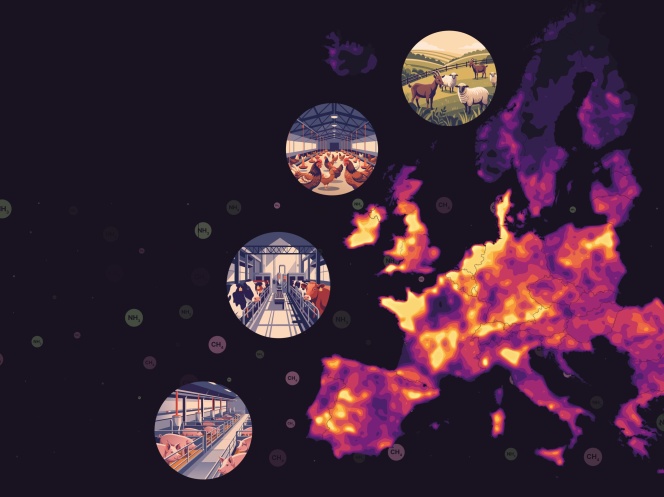
Research by the University of Oxford mapped livestock-related methane emissions at resolutions as fine as 1 km across 32 European countries, using national emissions totals reported to the UNFCCC. Inventories indicate that 9.36 million tonnes of methane was emitted in 2020 from enteric fermentation and manure management. This is virtually the same amount as US livestock methane in the same year, and the equivalent, over 100 years, of 284 million annual transatlantic passenger journeys.
A related story is told through the region’s ammonia (NH3 ) emissions. Inventories indicate that across the 32 countries, the main crop and livestock sources (manure, grazing, and inorganic fertilizer) emitted 3.5 million tonnes of NH3 in 2020. For manure managed in storage and housing, this amounted to almost 1.5 million NH3. Ammonia is a powerful air pollutant and precursor to PM2.5 causing respiratory and cardiovascular disease and contributing to local and regional air pollution. Nonetheless, 94% of the EU’s urban population is exposed to levels above WHO guidelines, and exposure to small particulate matter (PM2.5) caused an estimated 182,000 premature deaths in the EU in 2023. The economic losses from air pollution are significant, with some estimates putting it at €600 billion annually, or the equivalent of 4% of GDP. Italy is one of the worst affected, predicted to cost the country 6% of GDP until 2030. Despite this, of the main air pollutants in Europe, ammonia emissions have fallen the least and in some places have even increased.
Livestock pollution is concentrated in a small number of places.
Almost 60% (57.3%) of the livestock methane mapped across Europe comes from just five countries: France, Germany, the United Kingdom, Spain and Italy. This figure captures direct livestock methane emissions. The livestock sector also contributes GHG emissions beyond methane, including through the production of animal feed, which are not addressed here. Almost all cattle manure methane comes from manure managed in housing and storage systems: dairy cattle spend about a fifth of their time grazing (20.4%), yet manure dropped at pasture produces only 1.6% of their manure methane; for non-dairy cattle the figures are 40.2% and 5.4%.
The top 10% of EU regions (24 of 240) emit around two-fifths of the bloc’s livestock methane emissions.
The European livestock industry and the EU Commission itself promote the sector as one of the most “efficient” globally, meaning its emissions per litre of milk are lower than in other places, for example. However, the absolute total emissions from the sector remain stubbornly high. The European Scientific Advisory Board on Climate Change (ESABCC) highlights that a systemic transition in the food system is needed to stay on track with climate neutrality by 2050. This includes shifts in production and consumption that could lead to 50% reductions in non-CO2 GHG emissions from agriculture by 2050, compared to 2005 levels.
The same places produce both gases, tackling them one at a time is a missed opportunity
Pollutants from agriculture are intrinsically linked together, and of the top ten methane offenders across Europe, nine appear in the top ten ammonia polluters. Both gases must be tackled together to limit emissions and reduce the human and economic impact of pollution. The data reveals a highly unevenly distributed problem and is increasingly difficult to ignore.
Tackling powerful super-heating gases like methane and air pollutants like ammonia separately leaves significant gaps in the EU’s policymaking. Recent analysis from the Climate and Clean Air Coalition (CCAC) showed that addressing air and climate together reaps significant economic rewards, $15 for every $1 invested. Moreover, for Europe and the UK, dietary shifts would bring the greatest economic reward whilst reducing emissions and air pollution.
The biggest source sits outside the rules
Agriculture is responsible for a staggering 56% of the EU’s methane emissions, primarily from enteric fermentation, and 93% of the region’s ammonia emissions, with much of it produced from animal manure released during housing, storage and spreading. Global methane emissions, from both natural and human sources, are estimated to be responsible for 37% of background ozone levels in Europe, a harmful air pollutant, linked to global methane. Despite these clear statistics, an agricultural methane blind spot remains in EU policymaking, and existing ammonia regulations are failing to bring pollution down fast enough.
Regulation – what’s missing?
An absolute emission reduction target for agricultural non-CO2 emissions, including methane, remains absent from EU regulation. Although methane is included in the Effort Sharing Regulation (ESR), this only counts towards each Member State’s overall target under the ESR and does not specify any action for agriculture. Moreover, dietary shift alongside herd size reduction is recognised as the most effective lever to reduce emissions from this sector, but is not included in any EU commitments or strategies. As the EU’s largest source of methane emissions, this leaves the bloc out of step with the Global Methane Pledge. Ammonia is already subject to binding EU controls under the National Emission reduction Commitments Directive (NECD), but even when regulated, pollution from the agriculture sector remains exceptional and progress remains too slow. According to the EU Clean Air Outlook, under baseline assumptions, 21 of 27 Member States are projected to miss their ammonia (NH₃) targets in both 2030 and 2050, with the current Industrial and Livestock Rearing Emissions Directive (IED) and existing policies insufficient to deliver the required reductions. The need for structural changes in agricultural systems and behavioural changes, such as dietary shift is clear.
The European Environment Agency (EEA) identifies ammonia as the NECD’s most persistent challenge, with Member States needing further cuts to meet tougher 2030 targets. Intensive livestock farming and manure and slurry management are not only climate issues, but central to whether Member States deliver on existing clean air obligations. More than half of Member States still need to cut ammonia and PM2.5 emissions to meet their 2030 reduction commitments.
For methane, most emissions come from animal agriculture, primarily ruminants through enteric fermentation, but regulation in the region to minimise these emission sources is lacking. Agricultural non-CO2 GHG emissions have fallen by a mere 7% in the EU since 2005, and even where all existing policies are implemented, this is only projected to reach 15-22% reductions by 2050, far from the 50% recommendation from the European Scientific Advisory Board on Climate Change (ESABCC). The EU’s Methane Action Plan notes how agricultural methane emissions have ‘remained essentially stable’ between 2010 and 2020, despite reductions in the emissions intensity of livestock production. The NECD and the IED remain clear opportunities to invest in emission reductions from the sector, yet methane remains excluded from the NECD and cattle remain exempt from the IED.
You might also like...

Dairytales: Arla’s smokescreen for its lack of climate action
As the world's fifth largest dairy producer, Arla has been selling a dairy fairytale of sustainability to continue to escape climate sanctions while prioritising false solutions that further industrialisatio...

Feeding Us Greenwash: An analysis of misleading claims in the food sector
This report exposes the rampant greenwashing by the food industry and explores how consumers respond to green claims made by companies.

High Steaks: Taking methane from animal farming out of its blindspot
Methane emissions in the EU’s livestock sector are expected to drop by a mere 3.7% by 2030 with current policies, which means that the EU will not achieve its 30% commitments under the Global Methane Pledge.