Growth without Guardrails: The UN’s aquaculture policy is undermining food security
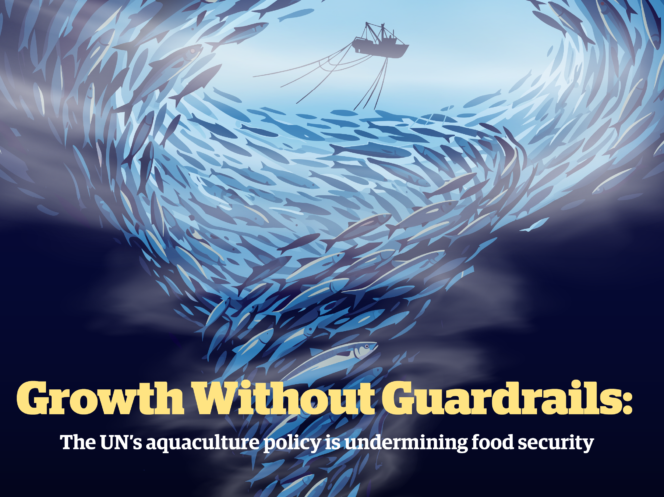
The Food and Agriculture Organization of the United Nations (FAO) was founded after the Second World War with a clear mandate: to raise levels of nutrition, improve access to food, conserve natural resources and help free humanity from hunger. It is promoting major expansion of aquaculture as a means of advancing food security, nutrition and climate action—but without establishing adequate safeguards to ensure that this growth supports those objectives. The FAO climate roadmap calls for at least 75% growth in global ‘sustainable aquaculture’ production by 2040 compared with 2020. Because FAO’s policies shape what governments, development banks, donors and businesses accept as sustainable, its target will influence aquatic food systems, food security, fishing livelihoods and the health of marine ecosystems for decades to come.
This report finds that FAO is promoting aquaculture growth without guardrails. Its roadmap and subsequent Guidelines for Sustainable Aquaculture (GSA) fail to distinguish between fundamentally different production systems or constrain the expansion of feed-intensive and environmentally damaging forms of aquaculture. Crucial protections addressing nutrition and competition between aquafeed and human food were also removed from the guidelines. Without reform, FAO’s expansion agenda risks contradicting its founding mission by increasing pressure on wild fisheries, diverting nutritious fish away from people and exacerbating food insecurity, especially for the most vulnerable in Africa and Asia, who rely on small fish as an important source of nutrition.
Aquaculture is the world’s fastest-growing food-production sector. It now produces more than half of the aquatic animals (fish, crustaceans, molluscs including cephalopods) consumed worldwide and is expected to drive most future growth in production. In 2024, the global trade value of farmed and wild-caught fish, algae, crustaceans and molluscs reached $183.1 billion. This was only about 1% below the combined $185.3 billion trade in beef, pork and chicken. In fact, aquatic foods represent a significant portion of the global food economy – approaching both global poultry and meat production in tonnes per year.
But aquaculture is not a single production model. It ranges from non-fed and low-trophic systems, such as mussels, oysters and seaweed, which require few external inputs and can provide ecological benefits, to intensive farming of salmon, sea bass, sea bream and shrimp, which relies on manufactured feed containing wild-caught fish, soy and other agricultural commodities. These systems have fundamentally different implications for food security, climate, biodiversity and resource use. Although FAO acknowledges this diversity, its push for growth does not translate these differences into clear priorities governing which production systems should expand.
While FAO says aquaculture expansion should be ‘sustainable’, neither its roadmap nor the GSA explains which species and production systems should deliver the additional production, how much feed and wild fish that growth could require or which forms of aquaculture should not expand.
To map the potential consequences, Changing Markets worked with world-class fisheries scientists at the Institute for the Ocean and Fisheries at the University of British Columbia to model different pathways to FAO’s 2040 target. The results show that the outcome depends on which species expand and how they are fed. If recent trends continue, aquaculture’s demand for wild fish would rise by 85–88%, reaching the equivalent of 29–38% of the entire global wild catch recorded in 2020. If growth is concentrated in feed-intensive species, demand could more than double, requiring the equivalent of nearly half the world’s annual wild catch. By contrast, reducing the amount of fishmeal and fish oil used in feed, while directing more growth towards species that require little or no wild fish, could allow aquaculture production to grow while reducing aquaculture’s demand for whole wild fish by up to 16–17% below 2020 levels.
Aquaculture’s hunger for fishmeal and fish oil has already grown dramatically. FAO data shows that its share of global fishmeal use rose from around 10% in 1980 to around 90% in 2024, while its share of fish-oil use increased from roughly 1% to 63%. Claims that the sector has grown without requiring more marine ingredients therefore obscure a fundamental shift: aquaculture has become the overwhelmingly dominant consumer of a finite supply, and under current growth patterns its absolute demand for wild fish is set to continue rising.
This pattern is already visible among major salmon producers: an assessment by FAIRR in 2025 of the world’s seven largest publicly listed salmon producers showed that five of the seven companies examined increased their absolute use of fishmeal or fish oil made from whole fish between 2020 and 2024- some by as much as 39%.
Financial analysts advising the industry are explicit about the resulting scarcity. Rabobank warns that rising aquaculture demand is colliding with ‘stagnant marine ingredient availability’, with fishmeal shortages potentially emerging as early as 2028 and fish-oil scarcity intensifying throughout the decade. The modelling commissioned for this report examines the underlying demand pressure: it shows how continued growth in feed-intensive species could sharply increase aquaculture’s requirement for wild fish, while a more diversified pathway could reduce it.
Of fish destined for other uses, primarily fishmeal and fish oil (FMF0), 90% has been classified as suitable for human consumption. These smaller pelagic fish are rich in protein, essential fats and micronutrients. Feeding wild fish to farmed aquatic animals can result in less fish coming out than is taken from the ocean. Recent research estimated that, depending on how the calculation is made, producing 1kg of fed farmed output could involve the death of as much as 1.78kg of wild fish. A 2024 study of Norwegian salmon production found eating wild feed fish directly yielded more food value than the salmon for six of nine key nutrients: salmon fillets retained only 18% of their calcium, 25% of their iodine and less than 75% of their iron, omega-3, vitamin B12 and vitamin A. Converting fish to FMFO and using these to feed farmed animals can convert nutritious and affordable food into a smaller quantity of generally higher-priced seafood, while losing nutrients in the process.
The consequences are already visible. In Senegal, an important West African FMFO production hub, feed factories compete for the same small pelagic fish that support local diets, artisanal fisheries and women-led processing livelihoods. Women are central to these local value chains: they buy fish landed by artisanal fishers, then smoke, dry, process and trade it through local and regional markets, making nutritious fish affordable and accessible far beyond the coast. When factories outbid them for increasingly scarce fish, the effects extend beyond lost income: they weaken local food distribution and household food security. Per capita consumption of small pelagic fish in Senegal halved between 2009 and 2018, while growing volumes of wild fish were diverted into fishmeal and fish oil. Although FMFO production was not the only cause, it greatly intensified competition for dwindling supplies of affordable fish. More farmed seafood produced for distant and wealthier markets cannot compensate communities for losing local access to nutritious fish.
Across West Africa, Changing Markets and Greenpeace Africa previously estimated that more than half a million tonnes of fish capable of feeding over 33 million people annually were instead being reduced into fishmeal and fish oil, largely for farmed fish and livestock production in Europe and Asia.
Although voluntary, FAO’s Guidelines for Sustainable Aquaculture, published in 2025, represent the first global policy instrument dedicated entirely to aquaculture governance. This report tests whether the GSA are consistent with wider food-security and human-rights frameworks and FAO’s own mandate. The UN Special Rapporteur on the Right to Food, Michael Fakhri, urged states to exercise “great caution” where industrial aquaculture intensifies ecological pressure or undermines local food systems. UN Special Rapporteur on Climate Change Elisa Morgera has similarly warned that using nutritionally valuable fish for industrial feed raises “serious human rights concerns” about declining access to food. Yet the GSA promotes growth without acknowledging that people’s access to nutritious fish must come before industrial demand for fish feed.
Through a forensic analysis of FAO guidance, successive GSA drafts and discussions surrounding a 2023 workshop on fishmeal and fish oil co-organised by the FAO and the fish feed industry, this report shows that the absence of guardrails was not simply an oversight. Earlier drafts of the GSA contained safeguards addressing the nutritional effects and food security implications of aquaculture trade and competition between aquafeed ingredients and human food. These protections disappeared from the final guidelines without any explanation. In their place, the GSA emphasises efficiency, innovation, mitigation and feed optimisation – approaches that permit continued expansion and closely mirror narratives advanced by the FMFO and aquaculture industries. Our analysis reveals a clear policy drift towards a framework more compatible with the aquaculture industry precisely as stronger protections disappeared.
Norway’s role runs through this shift in framing. As the world’s leading salmon producer, it supported the formative work on the GSA and a Norwegian fisheries official chaired the expert consultation that shaped their development. Norwegian government funding also supported 2022 FAO research exposing the conflict between FMFO production and human food needs in West Africa and a subsequent workshop convened to address it. Yet the later process moved away from the food-first limits recommended by the Norway-funded FAO study and towards a compromise framework that combined protections for direct human consumption with an accepted role for a continued “responsible” FMFO industry. Norway therefore helped shape the guidelines’ growth-oriented context as well as a parallel process through which a documented food-security conflict was reframed as something to be managed within continued FMFO production. Low-trophic and non-fed aquatic foods can contribute to nutrition with far lower resource demands, yet the GSA places these fundamentally different production models within the same broad growth framework.
Further growth in feed demand would fall on already stressed and increasingly climate-vulnerable fisheries. More than a third of assessed marine fish stocks are fished at biologically unsustainable levels. Recent El Niño disruption in Peru – a major global supplier of fish feed – demonstrates how quickly climate shocks can translate into global feed scarcity. Global anchovy production was reported to have fallen by as much as 40% year on year in 2026, while anchovy prices rose by 80% to an all-time high. Expanding feed-intensive aquaculture while remaining dependent on finite wild fish resources increases risks not only for marine ecosystems and food security but the industry itself.
If FAO is to remain aligned with its founding mandate, future aquaculture policy must move beyond broad expansion targets and efficiency metrics. It should place food security, human rights and ecological limits at the centre of decision-making. FAO should ensure that any targets for aquaculture growth focus on non-fed and low-trophic aquatic foods. Locally sourced fish should be prioritised for direct human consumption, with investment towards appropriate processing, storage and distribution that keep nutritious fish accessible and affordable where it is important to local diets, while supporting women processors and traders. FAO should also set a clear direction towards reducing and ultimately eliminating edible wild fish from aquafeeds. Finally, FAO should also promote plant-based foods and proteins as lower-impact pathways to better nutrition, adapted to local needs and contexts.
Without such reforms, the modelling warns of the negative consequences that the expansion of extractive aquaculture could bring: intensifying pressure on vulnerable wild-fish stocks, diverting nutritious and affordable fish from people and small-scale fishing communities and leaving fundamental questions of access, equity and resource allocation sidelined.
You might also like...

Atrapados: Cómo los supermercados españoles abordan el empleo de pescado salvaje en su cadena de suministro acuícola
This report looks at how effectively Spanish supermarkets are safeguarding the health of the oceans, through the sustainability of their farmed fish supply chains. Read our Spanish language report:
Floundering Around: An assessment of where European retailers stand on the sourcing of farmed fish
This report offers a comparative review of 49 leading European supermarket chains’ policies on farmed fish. Based on extensive research it identifies leaders and laggards.

Dans les mailles du filet. Comment les grandes surfaces françaises font face à l’utilisation de poissons sauvages dans les chaînes d’approvisionnement aquacoles
This report evaluates the performance of the eight biggest food retailers in France when it comes to protecting our oceans and offering their customers sustainably farmed fish and seafood.