Half of all global fish catch could be ground into fish feed under FAO growth plans – new report warns
Half of all global fish catch could be ground into fish feed under FAO growth plans – new report warns
-
A new investigation warns that FAO’s 2040 aquaculture growth plans could see 46% of the 2020 global wild-fish catch ground into fish feed.
-
Report reveals that food-security safeguards on diverting fish from food to feed removed from successive drafts of FAO aquaculture guidance.
-
FAO workshop organised in collaboration with marine-ingredients lobby failed to consider West African small-scale fishers’ call to stop turning edible fish into feed.
-
Report concludes that FAO’s aquaculture policy conflicts with its founding mandate and UN human rights warnings.
A new report from the Changing Markets Foundation reveals that the FAO’s target to grow aquaculture by 75% by 2040 risks pulling tens of millions of tonnes of nutritious wild fish out of oceans and into industrial fish feed every year – and reveals that key safeguards disappeared from FAO guidance meant to prevent this outcome.
In partnership with the University of British Columbia, Changing Markets Foundation modelled multiple pathways to the FAO aquaculture growth target and found that its impact on wild fish could vary dramatically depending on which species drive that growth. If current trends continue, up to 34.6 million tonnes of wild fish will be caught and fed to farmed fish every year by 2040. Should growth occur in more feed-intensive species such as salmon and shrimp, that number climbs to 41.4 million tonnes annually – nearly half (46%) of all wild fish caught worldwide, every single year.
Neither the FAO’s roadmap nor its Guidance on Sustainable Aquaculture (GSA) specifies which species or production systems should drive this growth. This gap leaves the door wide open for expansion in precisely the most feed-intensive, resource-hungry species – with no mechanism to stop it. The report has also uncovered that earlier drafts of the GSA did include safeguards addressing the nutritional and food security risks of aquaculture trade and consumption. Those safeguards were quietly stripped out with no explanation following a workshop that the fish feed industry itself co-organised with the FAO – during which concerns expressed by West African artisanal fishing organisations were not sufficiently taken into account in the final guidelines. The UN Special Rapporteur on Climate has previously warned that turning fish into fish food raises ‘serious human rights concerns’.
Senegal offers a preview of what’s at stake. As a major West African hub for fishmeal and fish oil (FMFO) production, factories compete directly with local communities for the same fish, and fish consumption fell by more than 10kg between 1999 and 2019. A 2021 Changing Markets report found that enough fish to feed 33 million people in the region is instead being turned into fish feed every year – and research shows nutrients are lost in the process.
Changing Market’s modelling found that in addition to two high risk scenarios, a third pathway exists where the FAO’s target could be met while keeping demand for whole wild fish well below 2020 levels through lower fishmeal and fish-oil use and a shift away from the most feed-intensive species. If more feed-intensive pathways are pursued, the report warns, the FAO’s own aquaculture strategy could actively undermine food security in communities most dependent on wild fish. This would be in direct opposition to the FAO’s founding principles.
Tara Ganesh, Senior Campaigner at Changing Markets said: “Instead of confronting the most damaging forms of aquaculture through clear, actionable guidance – as UN Human Rights experts have urged – the FAO has opted for growth without guardrails, contradicting its founding mandate to safeguard food security.
If that is not concerning enough, food security safeguards vanished from their guidance with no explanation only to be replaced by the industry’s preferred language. Is the FAO meant to guide industry, or is it the other way around? Rather than serving industry interests, we need the FAO to go back to its mandate: protecting people and nature”.
Muhammed Oyinlola, Aquatic Ecologist at the University of British Columbia, said: “Our modelling shows that the outcome of the FAO’s growth target is not inevitable. There are two pathways that put huge demand on fisheries already under pressure, but there is a more diversified option that favours growth in lower-input species and still achieves the roadmap’s ambition. This is why the detail on how a 75% increase in aquaculture could be met is so crucial – ambiguity leaves the door open to growth that threatens communities, fisheries and the climate”
Gaoussou Gueye, President of the African Confederation of Professional Artisanal Fisheries Organisations (CAOPA) said: “For West Africa’s artisanal fishing communities, the issue is simple: nutritious wild fish—particularly small pelagics—must first and foremost help feed local populations and secure the livelihoods of the region’s fishers, women fish processors, and traders. Aquaculture development cannot come at the cost of increased competition for these resources.
We therefore call on the FAO and governments to prioritise forms of aquaculture that genuinely complement artisanal fishing and do not rely on whole wild fish – suitable for human consumption – as feed, and to fully involve artisanal fishing organisations in the decisions that will shape the future of our aquatic food systems”.
You might also like...

Caught Out: How UK retailers are tackling the use of wild fish in their aquaculture supply chains
This report scores the top 10 UK supermarkets to assess how effectively they are addressing the ocean sustainability implications of the farmed seafood they sell, which remains largely reliant on the use of ...
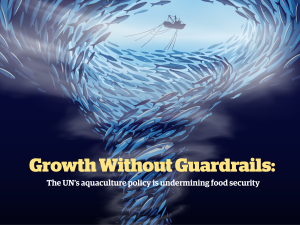
Growth without Guardrails: The UN’s aquaculture policy is undermining food security
This investigation reveals that the FAO's target to grow aquaculture by 75% by 2040 risks turning nearly half of the global wild fish catch industrial fish feed every year. Key food security protections aime...
Feeding a Monster: How European aquaculture and animal industries are stealing food from West African communities
This report uncovers how each year, over half a million tonnes of wild-caught fish are taken out of the oceans around West Africa and ground down into fishmeal and fish oil to feed farmed fish and animals.