Input to the European Commission Call for Evidence- Vision 2040 for Fisheries and Aquaculture
The Changing Markets Foundation, a Netherlands-registered NGO with offices in London, Utrecht and Brussels, welcomes the opportunity to contribute to the European Commission’s consultation on the Vision 2040 for Fisheries and Aquaculture. The EU’s initiative to develop a long-term strategic framework for aquatic food systems is both timely and necessary given the environmental, social and economic challenges facing the sector. However, for the Vision to be credible and coherent with EU environmental and food-system objectives, it must address a fundamental structural issue: the continued reliance of high-value carnivorous aquaculture on wild-caught, edible fish used for feed. Without addressing this dependency, aquaculture expansion risks increasing pressure on marine ecosystems and undermining food security in vulnerable regions.
As Ms Delilah Al-Khudhairy noted during her address to European Ocean Days in Brussels in early March 2026, not all aquaculture is the same and not all types afford the same ecosystem services. In this regard, there is a crucial difference in the sustainability of Low Trophic Aquaculture (LTA), compared to the harmful impacts of carnivorous finfish production on the environment, animal welfare and food security.
KEY CONCERNS
- Ensuring the Vision recognises the differences between aquaculture systems and establishes a hierarchy of sustainability of these systems
European aquaculture is often presented as a single sector, yet its environmental and social impacts vary dramatically depending on the production system. Some systems -particularly bivalve/mollusc and seaweed or algae farming -can deliver ecosystem services and provide nutritious food without requiring feed inputs. By contrast, fed aquaculture systems that rely on fishmeal and fish oil derived from wild fisheries raise significant sustainability concerns, as Changing Markets and numerous other civil society groups have repeatedly shown in the past. For this reason, the Vision 2040 should explicitly recognise the need to differentiate between aquaculture production systems, rather than promoting abstract sector-wide expansion.
2. Policy acknowledgement of the adverse impact of carnivorous aquaculture on wild fisheries, the environment and food security is urgently needed
A central sustainability challenge for the aquaculture sector is its reliance on fishmeal and fish oil (FMFO) derived from wild fisheries. Around a quarter of global marine fisheries catch is reduced to fishmeal and fish oil, with the majority used in aquaculture feeds. As much as 5 kg of edible wild fish may be used to produce 1 kg of farmed fish. When seen from the perspective of the number of fish, the numbers are even more shocking – with 56% of the total 2010 catch (1,000–1,900 billion fish) going into ‘reduction fisheries.’ Continued growth of carnivorous species such as salmon, shrimp, tuna, seabass and seabream will only increase this pressure on wild fish.
This raises several concerns- increased fishing pressure on already stressed marine ecosystems, the diversion of edible fish away from human consumption and related food security impacts in regions where reduction fisheries operate.
For example, research and investigations by Changing Markets and partners have documented how fishmeal production in West Africa diverts small pelagic fish -a key staple food -into global aquaculture supply chains. We have shown similar issues with other fish meal and fish oil (FMFO) producing regions including India, Vietnam and Peru. A recent study mapped over 500 fishmeal and fish oil factories across 63 producing countries, highlighting areas where these factories compete with local food security, undermining people’s livelihoods and damaging local ecosystems.
Another stark example of the impact growing EU carnivorous aquaculture is having overseas comes from Antarctica. The vast majority of the Antarctic krill fishery – widely recognised as ecologically sensitive – is used to produce feed for industrial aquaculture, as documented by Changing Markets. This fishery is now at the centre of a growing controversy involving companies that supply the salmon farming industry serving EU markets, a controversy which also embroils the certification label MSC that has recommended recertification of this fishery. As krill underpins the entire Antarctic food web, its exploitation for aquaculture feed highlights the structural unsustainability driving the carnivorous farmed fish sector.
Meanwhile Senegal, a key supplier of fish to global markets and a top ten supplier of fish meal to the EU, has seen per capita fish consumption fall from 32.2 kg in 2000 to 17.8 kg in 2019 [FAO] – a stark example of how countries underpinning supply chains for fishmeal and fish oil are experiencing declining access to fish as food. In recognition of the importance of small pelagic fish for their own food security, the government of Guinea-Bissau has recently prohibited their use in animal feed, prioritising it for human consumption instead.
Other recent research also indicates that several major salmon companies linked to European markets continue to source fishmeal and fish oil from these regions, despite longstanding concerns about local food security impacts. Rabobank has recognised that there are major wild fish shortages looming. EU policy frameworks governing aquaculture growth must follow suit and include language that explicitly recognises this and requires the phasing out the use of marine ingredients in fish feed.
3. Transparency gaps in aquaculture supply chains- feed efficiency metrics used by the carnivorous aquaculture industry do not capture total wild fish use
A major barrier to informed policymaking is the lack of transparency in aquaculture feed sourcing. In assessments of European retailers conducted by Changing Markets, we found that no companies publicly disclose the total quantity of wild fish used in the production of farmed seafood sold in their supply chains.
Instead, companies tend to report feed conversion ratios, percentage substitutions of fishmeal or point to their use of certification schemes. Current sustainability metrics used in carnivorous aquaculture often focus on relative efficiency improvements, such as declining Fish-In Fish-Out (FIFO) and similar ratios. However, these indicators obscure the overall ecological footprint of aquaculture, as papers by leading scientists have shown. While feed efficiency has improved in many cases, total aquaculture production continues to expand, meaning that the absolute demand for fishmeal and fish oil can remain high as the sectors continue to push for growth.
This illustrates a key policy gap: improvements in feed efficiency do not necessarily translate into sustainable levels of total wild fish use. For this reason, implementation of the Vision 2040 should move beyond relative efficiency metrics and require total wild fish inputs to be declared.
Apart from relying on selective metrics to show sustainability, the carnivorous finfish industry is highly inefficient even if seen through an animal husbandry lens. Estimates have recently shown that as many as 35 million fish have died in intensive salmon farming facilities in recent years.
Carnivorous fish farms have severe impacts on surrounding marine ecosystems and biodiversity and do not offer the additional ecosystem benefits of Low Trophic Aquaculture. This has been recognised in some EU member states, where plans to expand farms have been reconsidered as a result.
4. Affordability and market structure concerns
Aquaculture, blue foods and blue economy expansion is frequently framed as a pathway to providing affordable protein with little differentiation between Low Trophic and carnivorous aquaculture. Recent developments in the salmon industry raise questions about this narrative. Several major salmon companies are currently involved in competition investigations related to alleged cartel behaviour designed to maintain higher salmon prices. Similar cases have been brought in the UK and in the US. This raises worries that the sector may increasingly function as a high-value export industry rather than a provider of affordable protein, reinforcing the need for a more critical assessment of carnivorous aquaculture’s role in global food systems.
CONCLUSION
European aquaculture stakeholders often emphasise that European aquaculture has a vision but it needs a policy framework that enables it to become reality. We agree that a strong policy framework is essential. However, this framework must ensure that aquaculture expansion does not come at the expense of marine ecosystems, food security or livelihoods of coastal communities, either in the EU or elsewhere in the world. An important step that can be taken in this regard is to clearly distinguish growth targets by type of production, to require phasing out the use of fish meal and fish oil (FMFO) in feed and to promote consumption patterns that rely on eating less farmed fish and a more diverse range of locally sourced fish.
To ensure coherence with EU sustainability objectives, the Vision sand other EU policy frameworks governing aquaculture should prioritise the following actions:
- Differentiate aquaculture systems: Instead of abstract blanket growth targets, EU policy should distinguish between low-impact aquaculture (e.g. shellfish, seaweed) and wild fish feed-dependent carnivorous aquaculture – and promote only the former.
- Reduce reliance on wild fish for feed: The EU should establish clear pathways and targets to reduce the use of fishmeal and fish oil derived from wild caught
- Support regenerative low trophic aquaculture models: Public funding, educational or consumer facing drives and policy incentives should prioritise low trophic aquaculture systems that provide ecosystem benefits and require no/minimal feed inputs.
- Improve transparency and labelling:
- Ensure clearly visible and adequate labelling of aquaculture In addition to identifying the country of origin and production method, which is already required by law, labels should clearly identify the name of the producer and farm where the fish was produced. Online shoppers should be supplied with the same level of information as in-store shoppers.
- Require supermarkets and fish suppliers to report on the composition and origin of feed used and on key fish welfare We recommend that you use Compassion in World Farming’s species-specific toolkit to set key fish welfare reporting indicators and take into account updates and inputs from animal welfare groups to this consultation.
- Address global supply chain impacts: EU aquaculture policy must factor in food security and ecological impacts in third countries supplying fishmeal and fish oil.
Thank you for your attention to this feedback and we stand ready to liaise further with the EU on its vision and goals for the aquaculture industry going forward.
Changing Markets Foundation
Contact: tara.ganesh@changingmarkets.org Website: www.changingmarkets.org
You might also like...
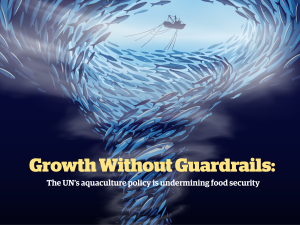
Growth without Guardrails: The UN’s aquaculture policy is undermining food security
This investigation reveals that the FAO's target to grow aquaculture by 75% by 2040 risks turning nearly half of the global wild fish catch industrial fish feed every year. Key food security protections aime...

Dairy and Coffee Methane Action Tracker
The third edition of our dairy and coffee methane rankings finds mixed progress among 23 major companies across Europe and North America. While eight companies now disclose their methane emissions and five h...
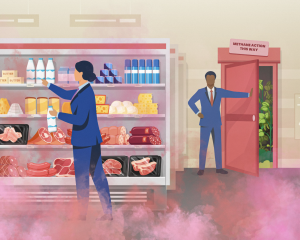
Shelved Again: Supermarkets’ Missing Action on Methane
This report examines the failure of the world’s largest food retailers to act on agricultural methane, despite their significant influence over global food systems. Assessing 20 major supermarkets, it finds ...