Special Edition October 2025 newsletter – Putting the spotlight on methane
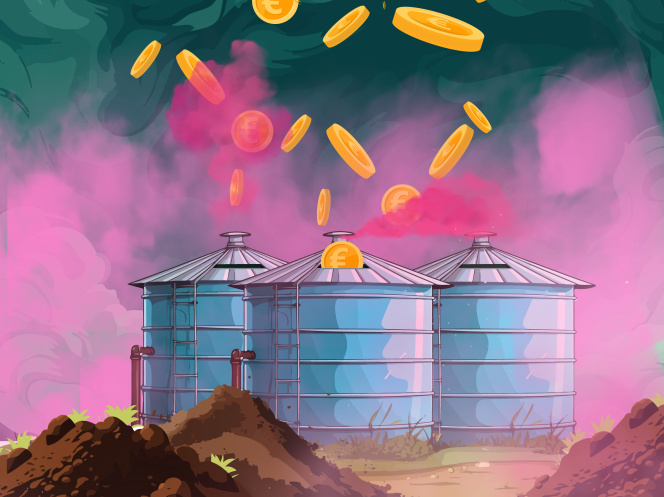
New report exposes the risks of unchecked biogas expansion
Agriculture accounts for 54% of the EU’s methane emissions, mostly from animal agriculture. Biogas and biomethane are widely promoted as renewable energy sources and a way for the agricultural industry to reduce methane emissions.
Earlier this month, we launched a new report with our partners in the Methane Matters coalition, Biogas policies in the EU: Levelling up or locking in?, which shows that the EU has promised the biogas industry billions of euros in public funding without a proper environmental impact assessment.
While biogas may play a role in reducing methane emissions when implemented well, without stringent environmental safeguards, it can make the problem worse. Our report draws on research by Profundo to expose major gaps that show the EU’s biogas boom risks locking in pollution, increasing industrial animal agriculture, and entrenching fossil fuel dependence for years to come. It shows how, under the Biomethane Industrial Partnership, industry itself defines what counts as sustainable, opening the door to greenwashing.
The report reveals how the EU has promised €37 billion in public funds for biogas, with another €28 billion committed from private investors, which could lead to an unsustainable lock-in. Much of the private capital is flowing to Spain, Denmark, and the UK, all of which are expanding industrial animal farming that pollutes local water and air.
Methane Matters conference
We launched the report in Brussels during our annual Methane Matters coalition’s conference, a counterpoint to the industry-led Biomethane week. The day featured presentations highlighting practical case studies from Denmark, Germany, and the UK, followed by panel discussions exploring methane challenges across agriculture, energy, and waste sectors. We saw more than 100 participants, including EU policymakers, researchers, industry representatives, farmers and civil society organisations.
A key focus was the urgent need for EU policy reform and greater recognition of methane’s role in air pollution. The afternoon session, co-hosted with Irish farming organisation Talamh Beo, was particularly impactful. The collective recently published a policy paper on addressing methane emissions in Ireland and, together with a network of agroecological farming groups, is facilitating crucial conversations with farmers about food systems transformation.
Explore Talamh Beo’s inspiring work
Methane unmasked
A significant weakness uncovered in our methane report is the extent of methane leakage from biogas operations. For example, in Germany, leaks from some biogas plants are comparable to Cyprus’s annual greenhouse gas emissions. Our own investigation into Danish biogas plants, conducted by Changing Markets and Deutsche Umwelthilfe earlier this year, not only measured leaks but also captured them on camera.
At the Shell-owned Nature Energy plant in Videbæk (formerly part-owned by Arla), methane concentrations reached over 5,000 parts per billion (ppb), more than double the regional atmospheric average of 2,077 ppb, coming from a compressor stack. A freedom of information request by Greenpeace Denmark further revealed that the Videbæk plant has a history of significant to major leaks and unsubstantiated sustainability claims.
At the Tønder biogas plant, one of Europe’s largest, atmospheric methane levels spiked to nearly 35,000 ppb, around 16 times background levels. While the precise source couldn’t be identified, such elevated levels raise serious concerns about regional methane leakage.
Denmark is one of Europe’s largest per-capita producers of biogas. While the country is among the few with regulations on methane leaks from biogas production, implementation remains an issue, as evidenced by our report. In showing these leaks, our investigation has made the invisible visible, raising serious questions about the industry’s ability to regulate itself.
Watch our investigation video and, for more info, check out our background briefing.
Farmers & scientists sound the alarm on GWP*
On 12 October, New Zealand announced it was backtracking on its methane reduction targets, which are now set at 14–24% methane cuts by 2050 compared to 2017 levels, from its previous target of 24–47%. This new target is in line with a “no additional warming approach”, meaning they have weakened their ambition to reach the same warming as 2017, rather than reducing their warming in line with their historical contribution, falling foul of industry pushes to change the goal posts of how methane is measured. This decision flies in the face of science, as expressed in this joint letter signed by eminent scientists earlier this year.
“No additional warming” uses GWP*, a controversial way of measuring methane emissions, which allows countries to effectively magic away their historic emissions. It could even allow countries using it to claim they are “cooling” the planet, all the while continuing to release huge amounts of methane into the atmosphere.
If you missed it, check out our webinar unpacking GWP* and this Carbon Brief article breaking it down (and referencing our work).
But farmers and scientists are not taking this lying down. Thomas O’Connor of Talamh Beo told the Irish Times that agroecological farmers are worried that Ireland could become the next country to follow New Zealand’s damaging approach, which could lock in high methane emissions that fuel climate disruption. They face powerful agribusiness interests spreading misleading narratives to obstruct climate action, and are urging the government to resist corporate pressure and prioritise people, the planet, and future generations. Professor Hannah Daly is among scientists in Ireland calling out the potential misuse of GWP*.
Future of Foods podcast
Our CEO, Nusa Urbancic, joined the Future of Foods Interviews podcast to talk about the importance of reducing agricultural methane emissions and expose the tactics Big Meat and Dairy deploy to delay climate action. Nusa discusses industry greenwash, why methane is a climate emergency brake, reasons to be wary of the biogas rush, the rise of misleading “regenerative agriculture” claims, the dangers of a coordinated misinformation campaign against food systems reform, and why independent journalism, online fact-checking, and credible science matter more than ever.
Historic win against TotalEnergies
In a landmark victory against corporate greenwashing, TotalEnergies has been found guilty of illegally misleading consumers by portraying itself as “a major player in the energy transition” while simultaneously expanding fossil fuel operations. The oil giant has been told to cease its deceptive advertising within a month and display the judgment prominently on its website for 180 days, with penalties of €10,000 per day for non-compliance.
The landmark decision is the first to rule that an oil and gas company’s net-zero claims constitute unlawful greenwashing. As the sixth-largest European oil and gas company involved in biogas, TotalEnergies is also capitalising on the unchecked expansion of biogas and biomethane in the EU and has plans to further expand in the US.
In 2024, the corporation deepened its influence in the Biomethane Industrial Partnership, when it was one of two private companies (alongside Italian gas company, Snam) elected to the board, the highest decision-making level.
Huge congratulations to the organisations that brought the charge, Les Amis de la Terre France, Greenpeace France, Notre Affaire à Tous, supported by ClientEarth.
In the media
- Carbon Brief: Q&A — What the ‘controversial’ GWP* methane metric means for farming emissions
- The Lancet (comment): Offline — Food and health—the unacknowledged emergency
- RTL Nieuws (Dutch): We are eating less meat, but the meatball debate continues
Our must-reads and listens
- Podcast, Drilled: How the Animal Ag Industry Obstructs Climate Policy (plus the free accompanying report: Climate Obstruction: A Global Assessment)
- Book: What We Can Know — a novel by Ian McEwan
- New research: Towards Sustainable and Ethical Food Systems: Exploring Consumer Motivations and Strategies for Plant-Based Eating
Welcome Izzy!
We are delighted to welcome the newest member of our team, Izzy Howden. Izzy started as Senior Campaigner in October 2025. Before this, she was Senior Campaign Manager at Make My Money Matter, where she led campaigns to tackle UK private-sector financing of fossil fuels and deforestation, and to unlock capital to fund the green transition. This included the viral Oblivia Coalmine campaign, which raised awareness of UK pension fund fossil fuel investments.
Before joining Make My Money Matter, Izzy developed strategic and creative campaigns for clients such as the Global Partnership for Education, the World Economic Forum, Peace One Day and Footprint Coalition. In her spare time, Izzy is an avid reader and enjoys sewing, drawing and cooking.
You might also like...
Tracking Methane Action in the Dairy, Coffee and Retail Sectors: October 2026 insights
The fourth edition of our methane rankings for major food company finds signs of momentum from dairy companies, progress from just one coffee company and continued leadership vacuum from retailers.
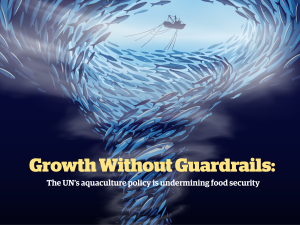
Growth without Guardrails: The UN’s aquaculture policy is undermining food security
This investigation reveals that the FAO's target to grow aquaculture by 75% by 2040 risks turning nearly half of the global wild fish catch industrial fish feed every year. Key food security protections aime...
Dairy and Coffee Methane Action Tracker: May 2026 insights
The third edition of our dairy and coffee methane rankings finds mixed progress among 23 major companies across Europe and North America. While eight companies now disclose their methane emissions and five h...