IMF, Microsoft and Peter Thiel-backed company among new faces of methane misinformation – new investigation
IMF, Microsoft and Peter Thiel-backed company among new faces of methane misinformation – new investigation
London, November 12 – As COP31 kicks off in Antalya, a new Changing Markets investigation sheds light on renewed attempts to dodge methane science, attack solutions and package livestock farming projects as carbon offsetting schemes, allowing countries to generate carbon credits under Article 6 of the Paris Agreement. The investigation reveals that national governments, tech giants, and financial institutions are buying from dubious carbon credits schemes to offset fossil fuel emissions, while governments from high livestock producing countries are aiming to reassess the methane accounting metrics to justify weakened climate targets.
Dubious livestock carbon credit schemes are being used to offset energy emissions
A series of powerful institutions have opted into contested carbon credit schemes linked to “regenerative grazing”, where cows are moved continuously to “improve soil health”. These organisations are buying claimed carbon removals from livestock operations while, in some cases, expanding energy-intensive infrastructure, even when the projects could increase livestock emissions.
The IMF bought 3,700 credits from SARA to offset its travel and shipping, even though SARA’s documents admit that increasing cattle numbers will increase enteric methane emissions. Singapore’s government purchased 625,000 credits from Chevron- and Yara-backed company Boomitra to use towards achieving its Paris Agreement targets under Article 6.2. Boomitra’s own documents say that reducing methane emissions is not an objective of the scheme.
Peter Thiel invested $76 million in Vista Energy, which plans to offset its oil and gas emissions with “rotational grazing” projects, a method that requires significantly more land. Microsoft’s 2026 Sustainability Report shows that its emissions rose 25% in the 2025 financial year, driven primarily by data center expansion. To offset these, it bought nearly 6 million credits, including from Agoro Carbon, who promote regenerative practices like rotational grazing, with the expectation that cattle numbers would remain stable. Yet the same project documents show 489 more cattle in the project scenario than in the baseline across participating fields during the monitoring period. In June of this year, Microsoft signed a 20-year natural gas deal with Chevron for its new Texas data center.
National governments are using junk-science to cook the books
The investigation also finds concerted efforts by the large meat and dairy producing countries New Zealand and Ireland to redefine how livestock methane is accounted for in order to weaken domestic agricultural emissions reductions. Through partnerships like the ‘Ireland-New Zealand Joint Research Initiative’, the two countries use claims of ‘temperature neutrality’ and ‘no additional warming’ drawn from the GWP* metric to argue that herd sizes and methane emissions can be maintained at the same level. The timing is significant: a COP27 decision requires countries to consider whether to update international methane metrics for reporting purposes by 2028.
In response to this movement, in May 2026, 42 climate scientists and academic experts, including 11 IPCC lead authors, warned that these claims would let high emitters claim climate neutrality without the cuts needed to limit warming to 1.5°C. An FOI request by Changing Markets into the ‘Ireland-New Zealand Joint Research Initiative’ found that one of its aims was to ‘strengthen JRI’s influence in international forums including the IPCC’.
‘Misinfluencers’ with murky links are spreading misinformation around feed additives and livestock farming
The report also reveals how misinfluencers attacked one of the few technical measures that has been approved by regulators in both Denmark and the UK. The campaign against Bovaer, a methane-reducing feed additive, generated nearly 12 million engagements on X and spilled over to other digital platforms, like TikTok and YouTube. Commentators like James Melville in the UK, founder of No Farmers, No Food – who also has links to climate denial networks like The Together Declaration – and Kent Nielsen in Denmark, whose name appeared in leaked documents linked to Russian State-funded operations, spearheaded the spread of misinformation around both the effect of Bovaer on cows, the need to reduce methane at all and conspiracy theories related to Bill Gates and the World Economic Forum. This campaign led to MPs including Alison Hume, Caroline Nokes and Restore Party leader Rupert Lowe amplifying misleading posts about Bovaer on social media, and Norwegian dairy giant TINE boycotting Bovaer-fed cattle.
Nusa Urbancic, CEO of Changing Markets said: “Regenerative grazing is a trojan horse in the carbon credits house of cards – our research shows that fossil fuel and tech companies are using this questionable methodology to offset the growing emissions from fossil fuels. Methane emissions are conveniently overlooked and downplayed. In essence, what we’ve found are efforts to convince us that more livestock farming is the way to cut methane emissions from livestock farming.
Carbon credit schemes, the backlash against Bovaer, a perfectly safe feed additive, and the attempts by national governments to cook the books and rewrite methane accounting rules reveal an industry hellbent on doing as little as possible to cut their climate impact”.
You might also like...

The New Merchants of Doubt: How Big Meat and Dairy Avoid Climate Action
This report reveals the tactics of Big Meat and Dairy companies to delay, distract, and derail action on transforming the food system, mirroring strategies used by the tobacco and fossil fuel industries.

Dangerous Distractions: How agribusiness narratives continue to undermine climate action
The climate emergency is escalating, yet Big Ag industry actors continue to push misleading narratives to undermine climate action as outlined in this briefing.
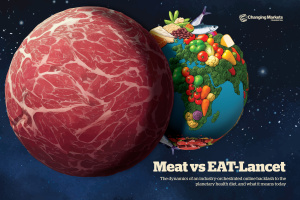
Meat vs EAT-Lancet: The dynamics of an industry-orchestrated online backlash
In October 2025, the EAT-Lancet Commission will publish EAT-Lancet 2.0 an update to the planetary health diet first released in 2019. While the first report is one of the most influential academic studies ev...