October 2025 newsletter – Tackling misinformation & greenwash in food systems
Read the Meat vs EAT Lancet report
Navigating narratives at Climate Week in New York
In advance of the update to the landmark EAT-Lancet “planetary health diet”, we released Meat vs. EAT-Lancet: The dynamics of an industry-orchestrated online backlash to the planetary health diet, and what it means today. The research takes a deep dive into the misinformation campaign that followed the original paper’s recommendation to “eat less meat and more plants”, laying the groundwork for today’s online food culture wars.
Through social media analysis combined with the analysis of freedom of information requests and leaked documents, we mapped the network at the heart of the ferocious opposition to the 2019 study. Our investigation identified the industry-friendly scientists, doctors, health influencers, journalists, and authors who drove the initial backlash.
We then traced what had happened since, including exposing how, despite its billing as a “scientific” conference, the 2024 Denver “summit” on meat and livestock was in large part an industry-sponsored PR exercise.
The report, along with a media comment debunking the false statement that environmentalists want to eliminate all cows, has been featured in more than 400 news stories from around the world. Highlights include the Associated Press, Bloomberg, CNBC, Delo, Deutsche Welle, El Publico, Le Monde, Mediapart, and Tagespiegel.
We released the report during Climate Week in New York, where we shared our research and strategised on how to overcome the challenges misinformation poses for food systems transformation.
We linked the release to an in-person event, co-organised with Brighter Green and the Center for Biological Diversity, which saw a room full of academics, journalists, and civil society gather to discuss how to navigate narratives on food and climate.
Journalist Lela Nargi moderated a panel featuring Nusa Urbancic, as well as Marlana Malerich (Rooted Research), Stephanie Feldstein (Center for Biological Diversity), Alexandra Tey (Center for Biological Diversity and Brighter Green) and Michael Silberman (Food Disinfo Lab). The discussion unpacked false narratives, how they spread, why they resonate, and what we can do to counter them. An interactive audience session brought these insights to life through real-world scenarios, highlighting both the challenges we face and the opportunities to shift the conversation.
The greenwash corner
Greenwashing is a close cousin of mis- and disinformation, and yet again, Nestlé is in the spotlight. As shown in this Bloomberg article, featuring our CEO, Nusa, the company has abandoned its commitment to the Dairy Methane Action Alliance, a voluntary initiative set up to reduce methane emissions from dairy operations.
The initiative was launched two years ago, with Nestlé enjoying positive PR for taking part, enabling the company to continue its bid to be seen as a “climate leader” without taking much action. The Dairy Methane Action Alliance is far from perfect; it only asks for methane disclosure and action plans, but not targets. Apparently, even these basics are too much for Nestlé, the world’s largest food company, which rakes in billions in profits.
We suspect Nestlé’s quiet quitting may be related to a recent leadership change, raising questions about what this says about its new CEO, Philipp Navratil’s commitment to climate action.
Ultimately, the move proves, yet again, what we have been saying for years: voluntary commitments are easy to make but also easy to break. We need to see government-led regulation to address the agricultural methane crisis and hold companies to account for their massive emissions.
In the media
- Deutsche Welle: Online attacks threaten major climate-friendly diet report
- Le Monde (French): Meat lobby surrounds itself with ‘mis-influencers’ to discredit scientific work on diets
- Forbes: Can Anti-Climate Lobbying Decide Our Planet’s Future?
- Bloomberg: Nestle Bows Out of Initiative to Reduce Dairy’s Climate Impact
Our must-reads and listens
- Drilled: The Psychology of Misinformation: Why Does It Work So Well?
- The Guardian: Inside the everyday Facebook networks where far-right ideas grow
- Reuters Institute (podcast): How people check if information is real or fake
- Groupe d’études géopolitique: Disinformation, Climate and Democracy in the age of the Anthropocene
You might also like...
Tracking Methane Action in the Dairy, Coffee and Retail Sectors: October 2026 insights
The fourth edition of our methane rankings for major food company finds signs of momentum from dairy companies, progress from just one coffee company and continued leadership vacuum from retailers.
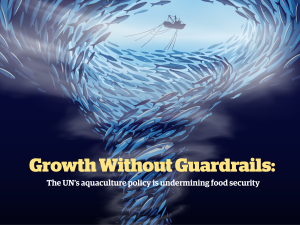
Growth without Guardrails: The UN’s aquaculture policy is undermining food security
This investigation reveals that the FAO's target to grow aquaculture by 75% by 2040 risks turning nearly half of the global wild fish catch industrial fish feed every year. Key food security protections aime...
Dairy and Coffee Methane Action Tracker: May 2026 insights
The third edition of our dairy and coffee methane rankings finds mixed progress among 23 major companies across Europe and North America. While eight companies now disclose their methane emissions and five h...